Most land clearing in the Tallahassee area runs somewhere between $1,500 and $6,000 per acre in 2026, but that range is so wide it is almost useless on its own. The number that actually lands on your quote depends on the method, what is standing on the ground, and how hard it is to get a machine to it.
This guide breaks down what each clearing method costs per acre, what pushes a Big Bend acre toward the top or bottom of the range, why a wooded acre in Leon County can cost three times what an open one does, and why any contractor quoting you off a satellite image is guessing.
Land clearing in the Tallahassee area typically costs $1,500 to $6,000 per acre, depending on method and vegetation. Light underbrush runs at the low end, forestry mulching sits in the middle, and full clearing with stump removal and haul-off sits at the top. Heavily wooded acreage with mature hardwoods can exceed those figures.
Here are working budget ranges for the Big Bend. Treat these as planning numbers, not quotes.
Method | Typical range per acre | Best suited to |
|---|---|---|
Underbrush clearing (light brush, briars, saplings) | $1,200 to $2,500 | Overgrown but not timbered ground |
Forestry mulching (standard density) | $2,000 to $4,000 | Mixed pine, palmetto, understory, stems under about 8 inches |
Forestry mulching (heavy density) | $3,500 to $5,000+ | Thick titi, dense stems, larger material |
Full clear with stump removal and haul-off | $4,500 to $8,000+ | Build sites needing bare, gradeable dirt |
Stump grinding (standalone, per stump) | $100 to $500 | Leftover stumps after tree work |
Rough grading (add-on) | $800 to $2,000 | Site prep after clearing |
Nationally, the Angi 2026 cost data puts professional land clearing at $1,395 to $6,168 per acre, and hourly work at $110 to $250 per hour. Florida-specific reporting lands in a similar band, with most projects between $1,500 and $6,000 per acre. Our local ranges sit inside that, adjusted for what Big Bend ground actually looks like.
One structural note that catches people off guard: mobilization is a fixed cost. Getting equipment loaded, hauled, and set up costs the same whether you have a half acre or five. That is why a small lot almost always carries a higher effective per-acre rate, and why per-acre pricing improves as acreage goes up.
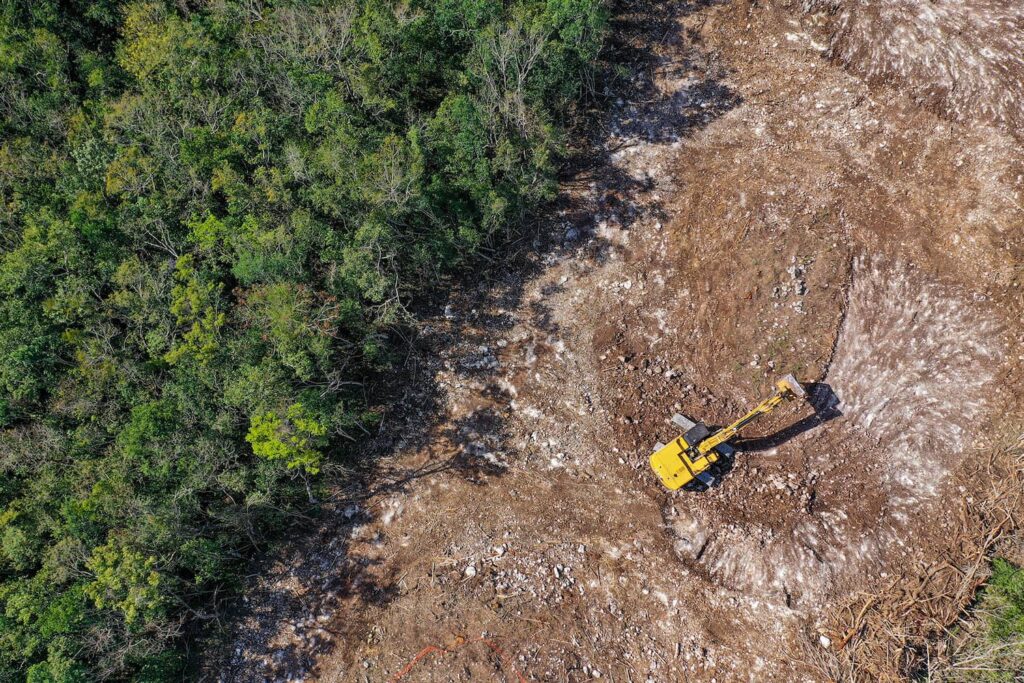
The biggest cost drivers are vegetation density, stem diameter, what happens to the debris, stump handling, site access, and ground conditions. Density and diameter set the machine hours. Debris disposal and stumps decide whether you are in a mulching budget or a full-clearing budget. Access and wet ground can quietly add 25 percent or more.
Run down this list and you can usually predict where your own property lands.
An open or lightly overgrown acre in Leon County might clear for $1,200 to $2,500. A genuinely wooded acre with mature hardwoods can run $4,500 to $8,000 or more. The gap comes from machine hours, debris volume, stump work, and, in Leon County specifically, the permitting and mitigation triggered by protected trees.
This is where local knowledge changes the math, and it is the part generic national cost calculators miss entirely.
Under Leon County Code section 10-4.362, any tree 18 inches DBH (diameter at breast height) or greater is a protected tree and cannot be removed or damaged without permit approval. That threshold is the hinge your budget swings on.
Consider two acres, both technically “wooded”:
Same word, “wooded.” Very different invoices. Density of palmetto, titi, and greenbriar underneath the canopy also matters more here than most people expect, because it is invisible from above and it is what actually slows the machine down.
Often, yes. Leon County requires an environmental management permit from Development Support and Environmental Management before development activity or before removing or damaging any protected tree, defined generally as any tree 18 inches DBH or larger. Smaller vegetation management work may fall under a Vegetation Management Plan. City of Tallahassee properties fall under the city’s own code.
Permitting is a budget item, not just paperwork, and it is where uninformed projects get expensive.
Per Leon County’s environmental permitting guidance, tree removal permits are issued either as a stand-alone permit for limited removal or in combination with a stormwater or environmental permit, and Vegetation Management Plans cover minor soil disturbance and changes to existing vegetation, including forest management on lots without an agricultural exemption from the Leon County Property Appraiser.
A few practical notes:
Ask any contractor you talk to who is pulling the permit. If they shrug, that is your answer about how the rest of the job will go.
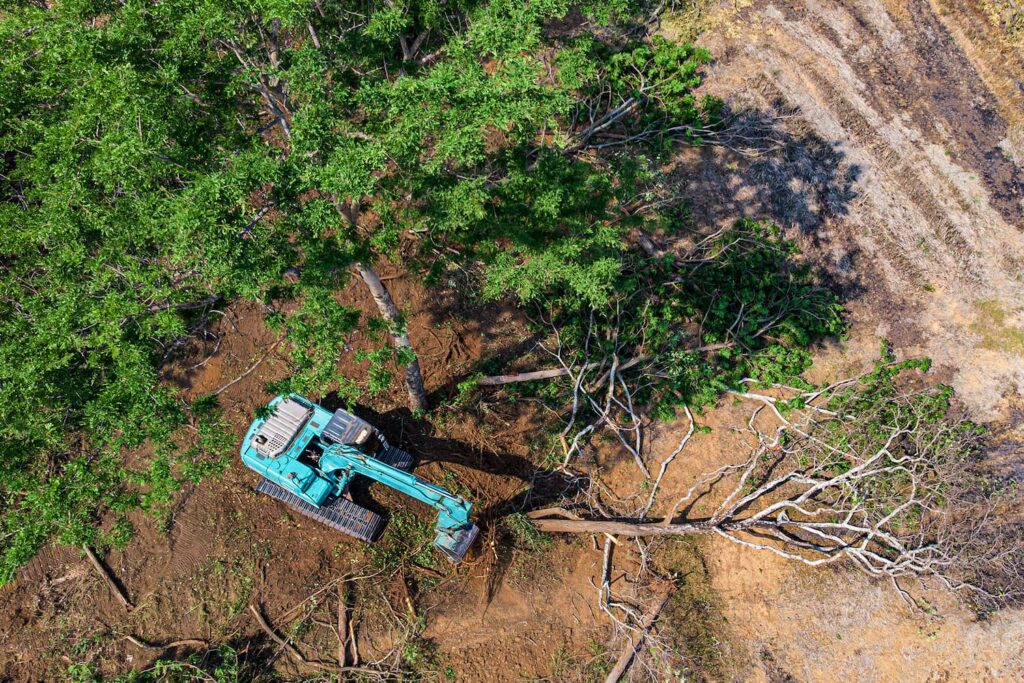
A quote based on satellite imagery is a guess dressed up as a number. Aerial views cannot show stem diameter, understory density, ground moisture, access constraints, or property line accuracy. Imagery is often years out of date, and North Florida vegetation regrows fast enough to make an old photo actively misleading.
If a contractor gives you a firm per-acre price without walking the property, be skeptical, because here is everything that image is hiding.
The pattern to watch for: a low aerial number that becomes a change order once the machine is on site and the crew finds what is actually growing there. A walked property produces a real number, and a real number is the only one you can budget against.
Compare quotes on scope, not just the bottom line. A written quote should specify what gets cut, how debris is handled, whether stumps are included, what finish grade you end up with, who pulls permits, and what erosion control is provided. Two quotes with the same dollar figure can describe completely different projects.
Before you sign anything, make sure the scope answers these questions in writing:
Once you know which method fits your property and your budget, the next step is a site-specific number. Our forestry mulching service page and lot clearing service page cover what each service includes and how to get a walked quote for your parcel. For overgrown ground that does not need full clearing, see underbrush clearing.
Most single acres run $1,500 to $6,000 in 2026. Light underbrush sits near the bottom, standard forestry mulching lands around $2,000 to $4,000, and a heavily wooded acre requiring stump removal and haul-off can reach $8,000 or more. Vegetation density and debris handling drive the difference.
Usually, yes, because it eliminates hauling and disposal. Mulching typically runs $2,000 to $4,000 per acre for standard density, while full clearing with stump grubbing and haul-off commonly runs $4,500 to $8,000 or more. The right choice depends on whether you need bare, gradeable dirt or just cleared ground.
Often. Leon County requires an environmental management permit before development activity or before removing any protected tree, generally any tree 18 inches DBH or larger. Some work falls under a Vegetation Management Plan, and certain removals are exempt. Confirm requirements with the county before any machine starts.
Diameter and density, most likely. Large trees mean more machine hours, far more debris volume, and stump work. In Leon County, trees at or above 18 inches DBH also trigger permitting and potential mitigation. Understory like palmetto and titi adds hours that are impossible to see from the road.
No. Satellite imagery cannot show stem diameter, understory density, soil moisture, access limits, or accurate property lines, and imagery in this area is often outdated while vegetation regrows quickly. A sight-unseen number is a guess, and it usually becomes a change order once work begins.
Starting at
/day
Free walkthrough. Exact price after on-site assessment.
No spam. Direct reply from us within two business days.